
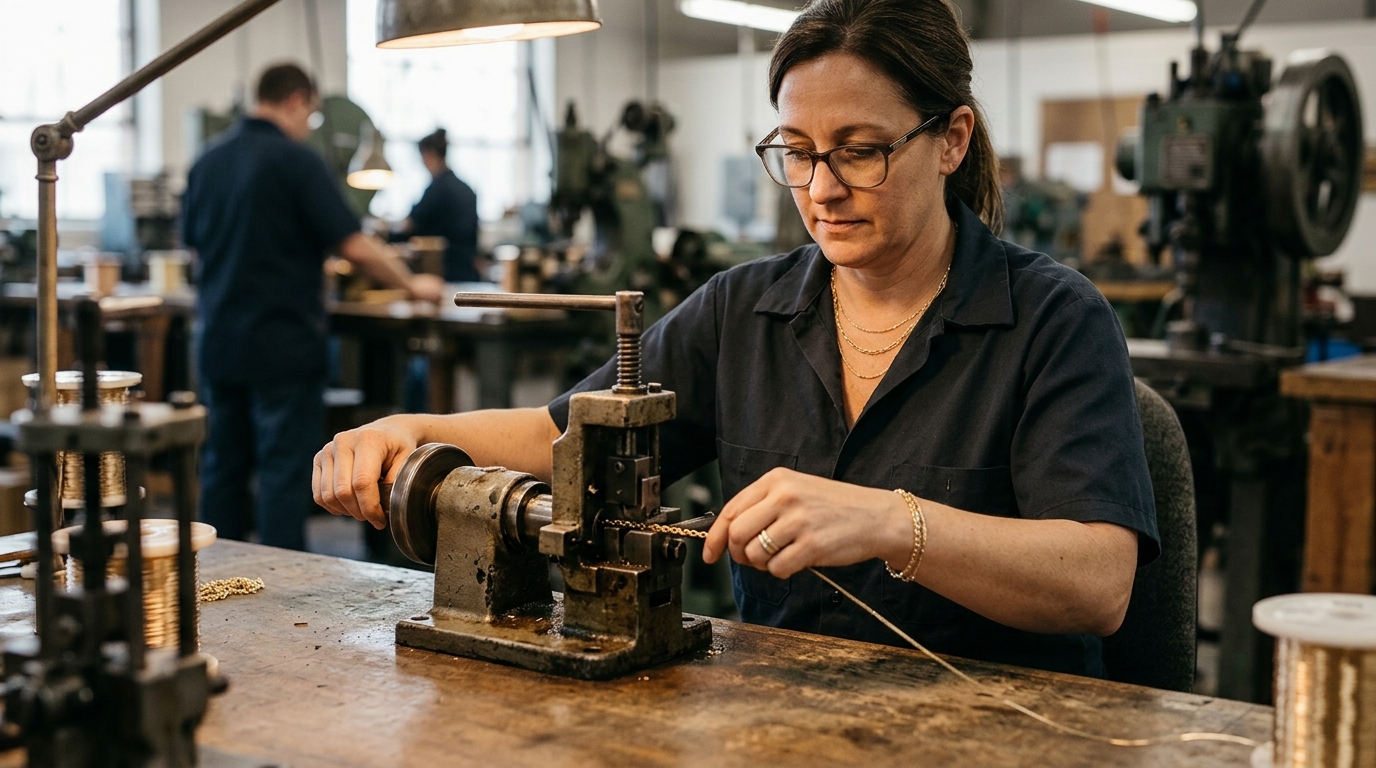
Walk through any wholesale jewelry marketplace and you will see dozens of companies calling themselves “manufacturers.” The word gets stretched until it loses all meaning. A brand that imports finished chains from overseas, slaps on new packaging, and resells at wholesale is not a manufacturer—it is a distributor. Understanding the difference matters when you are sourcing gold-filled jewelry for your business, because true manufacturers control the bonding process, the wire drawing, the chain forming, and the quality of the final product.
Below is a curated look at companies that genuinely manufacture gold-filled jewelry or components inside the United States, along with guidance on how to tell a real maker from a company that merely markets the label.
What Does “Manufacturer” Actually Mean in Gold-Filled Jewelry?
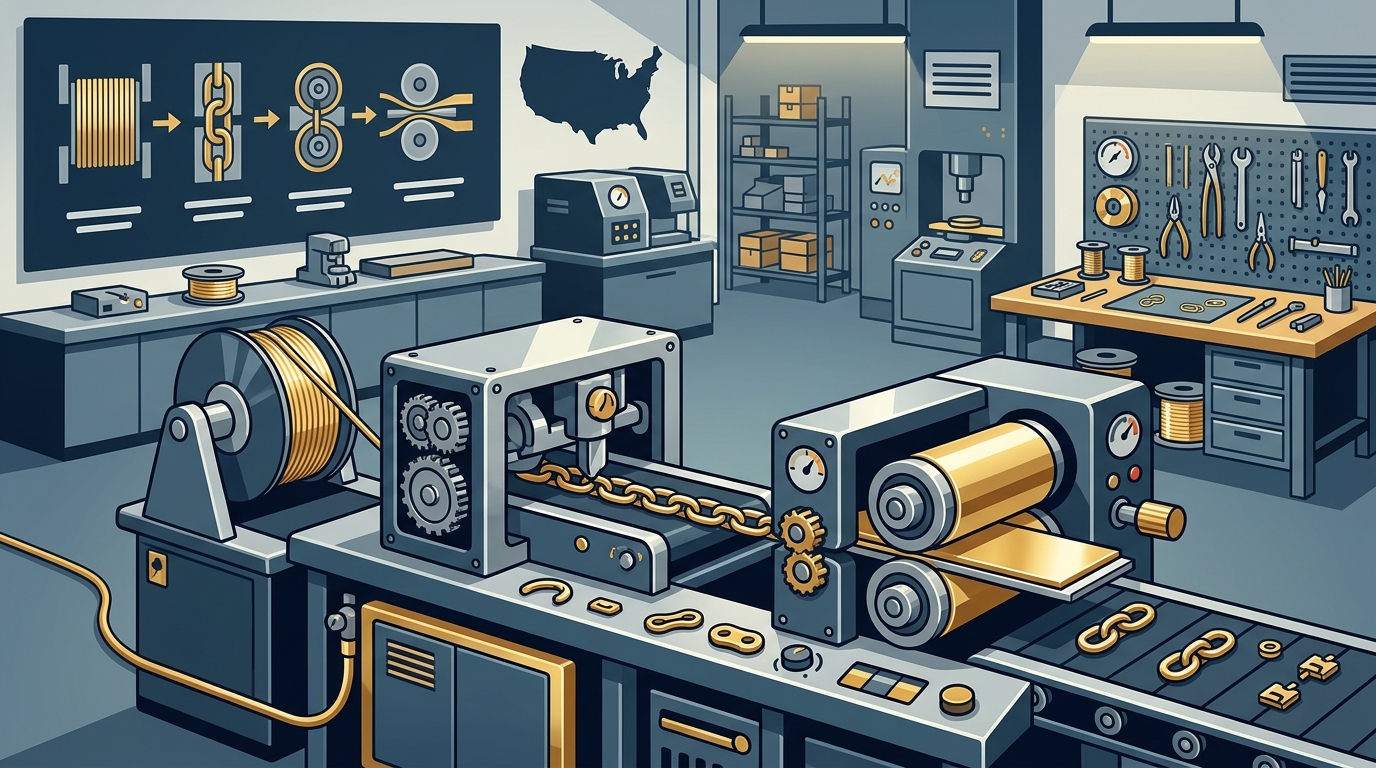
A legitimate gold-filled manufacturer takes raw materials—a karat-gold shell and a base-metal core—and bonds them together using heat and pressure. The bonded metal is then drawn into wire, rolled into sheet, or formed into chain links on-site. This is a capital-intensive process that requires specialized equipment: wire-drawing mills, diamond dies, chain-forming machines, soldering lines, and finishing departments.
Many companies that call themselves manufacturers are actually assemblers or wholesalers. They purchase pre-made gold-filled wire or chain from a domestic or overseas mill, then cut, clasp, and package it. There is nothing wrong with that business model, but it is fundamentally different from manufacturing. When evaluating a supplier, ask: Do you bond the gold layer to the base metal in your own facility? That single question separates makers from middlemen.
Verified Gold-Filled Jewelry Manufacturers Operating in the USA
1. JK Findings — Rochester, New York
JK Findings is one of the most established names in the American gold-filled supply chain. Founded in 1975 by John Kaupp, the company started as a small wholesale operation in Newark, New York, and has grown significantly over five decades. Today it operates out of Rochester, NY, with a global footprint that includes a sales office in Hong Kong.
What makes JK Findings a genuine manufacturer is the scope of its in-house production. The company reports that over 70 percent of its product offerings are made in the USA, produced at its Rochester manufacturing plant as well as contract facilities. Its catalog spans 10K, 14K, and 18K karat gold; 1/20 10K, 12K, and 14K gold-filled; and .925 sterling silver findings, chain, wire, and finished jewelry. In early 2025, JK Findings acquired Grassmann-Blake Inc., a clasp manufacturer, further expanding its domestic production capabilities.
2. Garlan Chain Company — Massachusetts
If your business revolves around chain, Garlan is likely already on your radar. This family-owned company has been manufacturing sterling silver, gold-filled, and base-metal chains since 1967—nearly sixty years of continuous domestic production. They produce a wide variety of chain styles including cable, curb, rope, bar, rolo, and figaro, and they use exclusively 14/20 gold-filled wire (a 14-karat gold shell comprising 1/20th of the total weight).
Garlan sells wholesale in bulk by the foot or cut and assembled to buyer specifications. They also manufacture their own findings—spring rings, lobster claws, and jump rings—in gold-filled, sterling silver, brass, and stainless steel. The fact that they draw their own wire and form their own links in-house makes them a true manufacturer, not simply a reseller.
3. Ball Chain Manufacturing Co. — Mount Vernon, New York
Ball Chain Manufacturing has been a family-owned operation since 1938, headquartered in a 70,000-square-foot production facility in Mount Vernon, New York, just north of New York City. While the company is best known as the world’s largest ball-chain maker—producing millions of feet per week and serving as the exclusive supplier of dog-tag chain to the U.S. Armed Forces—it also manufactures gold-filled ball chain and jewelry components.
Their gold-filled product line includes chain spools, pre-cut chains, and crimp covers. The company is ISO-certified and recognized as a certified green business by the Green Business Bureau, which adds a sustainability credential that many modern jewelry brands value in their supply chain.
4. CGM Findings — Los Angeles, California
Based in Los Angeles, CGM Findings specializes in gold-filled findings sold at wholesale. While smaller in public profile than JK Findings or Garlan, CGM has built a reputation among independent jewelers and small-batch designers on the West Coast for providing competitively priced gold-filled components. Their location in the LA jewelry district gives them proximity to one of the country’s largest concentrations of jewelry professionals.
5. Ross Metals — New York City (Diamond District)
Ross Metals operates from the heart of Manhattan’s Diamond District and has been in business for over 40 years across three generations. The company is a wholesale manufacturer and supplier of gold, silver, platinum, and gold-filled jewelry products. What distinguishes Ross Metals is its vertically integrated approach: the company melts and refines its own gold in-house, recycling scrap metal and unused materials to manufacture new products. That closed-loop process is a hallmark of genuine manufacturing, not simple resale.
6. Atamian Manufacturing Corp.
A lesser-known but legitimate manufacturer, Atamian produces 14K, 10K, gold-filled, and sterling silver beads, stampings, chains, and semi-finished jewelry components. They also handle custom orders in 9K and 18K. Their focus on component manufacturing—stampings, beads, and semi-finished parts—means they serve other jewelry makers rather than end consumers, which is a strong indicator of true manufacturing capability.
7. Armbrust International
Armbrust International manufactures sterling silver, gold-filled, and gold chains and clasps. Like Atamian, Armbrust occupies the component-manufacturing tier of the supply chain, producing the raw building blocks that designers and assemblers turn into finished jewelry.
8. Rebekah Gough Jewelry — Seattle, Washington
On the artisan end of the spectrum, Rebekah Gough Jewelry handcrafts gold-filled pieces in a Seattle-based studio. This is a small-batch operation where every item is made by hand, offering a very different value proposition from the industrial-scale manufacturers above. For retailers who want a “handmade in the USA” story behind their gold-filled inventory, studios like this fill an important niche.
How to Tell a Real Manufacturer from a Reseller
| Question to Ask | Manufacturer’s Answer | Reseller’s Answer |
|---|---|---|
| Where is the gold bonded to the base metal? | In our own facility or a named domestic mill | Vague or “our overseas partner” |
| Can I tour the production floor? | Yes, by appointment | We don’t have a production floor |
| What is the gold-filled grade you use? | Specific answer, e.g., 1/20 14K | Generic “high quality gold filled” |
| Do you draw your own wire? | Yes, or we source bonded rod and draw in-house | We purchase finished wire/chain |
| What is your minimum order? | Often by the foot, troy ounce, or gross | Usually per finished piece |
Why the Distinction Matters for Your Business
- Quality control: A manufacturer who bonds its own gold-filled material can guarantee the karat purity and layer thickness. A reseller is trusting someone else’s quality standards.
- Price transparency: True manufacturers price based on metal markets and production costs. Resellers add a margin on top of the manufacturer’s price.
- Customization: Need a non-standard wire gauge or a proprietary chain pattern? Only a manufacturer with in-house tooling can accommodate that.
- Regulatory compliance: FTC guidelines require that gold-filled items contain at least 1/20th gold by weight. Dealing directly with the manufacturer who performs the bonding gives you better documentation and traceability.
Key Takeaways
- Many companies in the gold-filled jewelry space use the word “manufacturer” loosely. True manufacturing involves bonding a karat-gold layer to a base metal, drawing wire, and forming components in-house.
- Verified US-based gold-filled manufacturers include JK Findings (Rochester, NY), Garlan Chain (Massachusetts), Ball Chain Manufacturing (Mount Vernon, NY), Ross Metals (NYC), CGM Findings (Los Angeles), Atamian Manufacturing, and Armbrust International.
- Ask pointed questions about bonding processes, facility tours, and gold-filled grades to distinguish real makers from resellers.
- Sourcing from a genuine manufacturer gives you better quality control, pricing transparency, customization options, and FTC compliance documentation.
Frequently Asked Questions
What is gold-filled jewelry and how is it different from gold-plated?
Gold-filled jewelry is made by bonding a thick layer of karat gold (typically 14K) to a base metal core using heat and pressure. By FTC standards, the gold layer must constitute at least 1/20th (5%) of the item’s total weight. Gold-plated jewelry, by contrast, uses electroplating to deposit an extremely thin gold layer—often less than 0.5 microns—onto the surface. Gold-filled pieces are significantly more durable and resistant to tarnishing than gold-plated alternatives.
How many real gold-filled jewelry manufacturers exist in the USA?
The number of companies that actually bond gold to base metal and produce gold-filled wire, chain, or findings in US-based facilities is relatively small—likely fewer than two dozen. Many businesses that advertise as manufacturers are actually wholesale distributors or assemblers who purchase pre-made gold-filled materials from domestic or overseas mills.
Is JK Findings a real manufacturer?
Yes. JK Findings has been manufacturing precious-metal findings and jewelry since 1975. The company produces over 70 percent of its products at its Rochester, NY manufacturing plant, with additional production at contract facilities. They offer gold-filled items in 10K, 12K, and 14K grades.
What should I look for when choosing a gold-filled jewelry supplier?
Ask whether the supplier bonds its own gold-filled material or purchases pre-bonded stock. Request specific grade information (e.g., 1/20 14K). Inquire about facility tours, minimum order quantities, and whether they can provide material certifications or assay reports. A supplier who can answer these questions in detail is far more likely to be a genuine manufacturer.
Why do so many jewelry companies call themselves manufacturers when they are not?
The term “manufacturer” carries prestige and implies quality control. Many wholesale distributors and assemblers adopt the title for marketing purposes because buyers associate it with lower prices and higher reliability. There is no industry-wide enforcement mechanism that prevents a reseller from using the word, so the burden of verification falls on the buyer.